Bonsai 27B: How a 27B Model Fits in Your Pocket
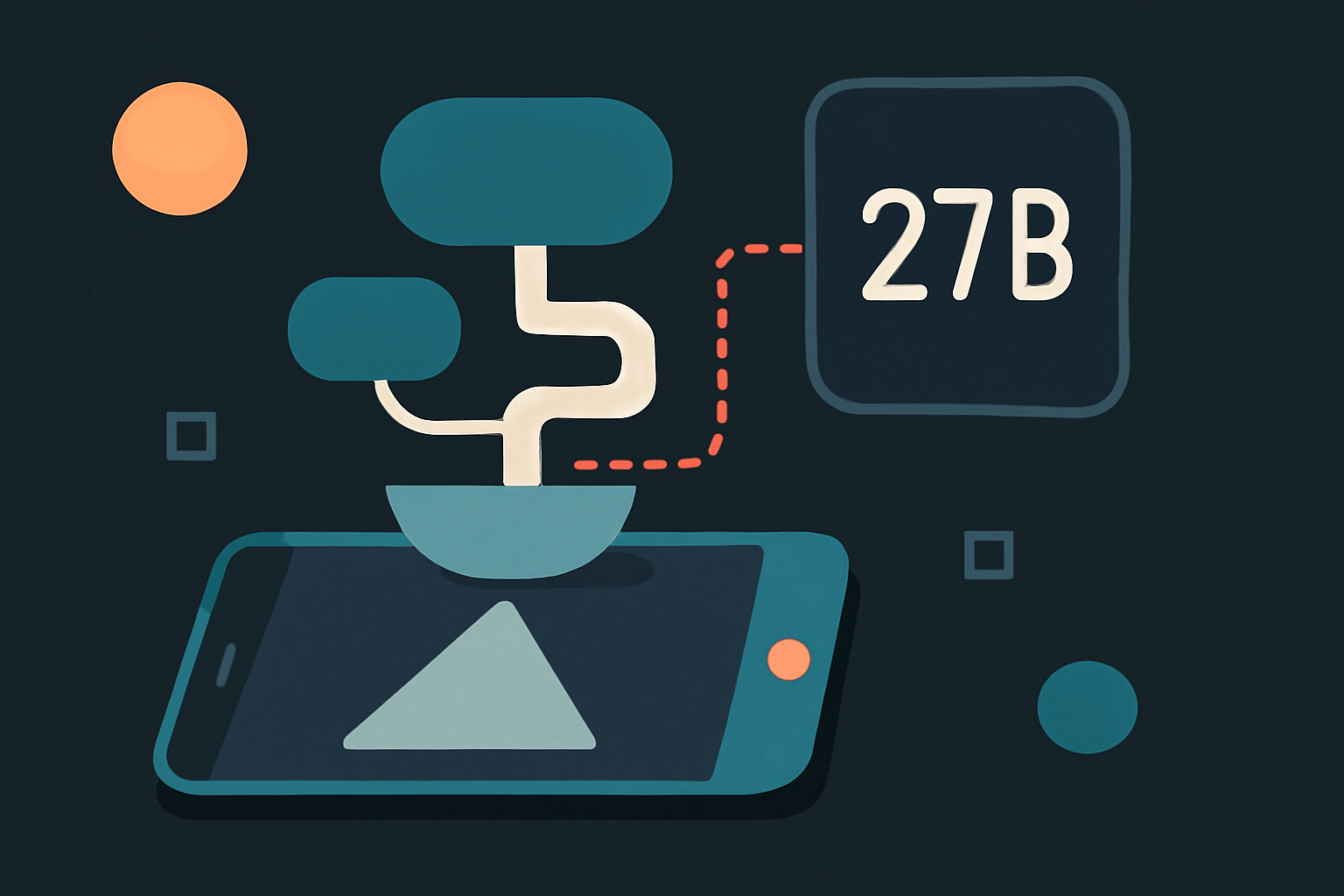
For years, the most capable AI models have lived in the cloud — sprawling across GPU clusters, demanding specialized hardware, and requiring a stable internet connection just to answer a question. The idea of running a 27-billion-parameter model on a smartphone felt like science fiction.
That's what makes the arrival of Bonsai 27B so striking. Built by the team at Prism ML, Bonsai 27B is a 27B-class model specifically engineered to run directly on consumer devices — including phones. It's not a stripped-down toy. It's a genuinely capable model that fits within the memory and compute constraints of modern mobile hardware.
Let's unpack what this actually means and why it matters.
What Makes On-Device 27B Models So Hard
Running large language models locally is fundamentally a memory problem. A standard 27B model in 16-bit floating point requires roughly 54GB of RAM — far beyond any phone on the market. Even aggressive 4-bit quantization typically lands around 13–15GB, still too large for most mobile hardware.
Getting a model of this class onto a phone isn't just about quantization. It requires rethinking the architecture from the ground up: how attention is computed, how layers are structured, how activations are managed, and how inference is scheduled across heterogeneous chips (CPU, GPU, and neural processing units working in concert).
Bonsai 27B appears to tackle this through a combination of architectural efficiency and aggressive optimization — delivering outputs that punch above the weight you'd expect from a model constrained to run locally.
Why This Is a Big Deal
The implications cut in several directions at once.
Privacy becomes a default, not a feature. When inference happens on-device, your prompts never leave your phone. For healthcare, legal, and personal use cases, that's not a nice-to-have — it's essential. On-device models make privacy-first AI applications genuinely viable at the capability level people actually need.
Offline capability changes the access equation. Billions of people around the world have smartphones but unreliable internet. Cloud-dependent AI is, by definition, unavailable to them much of the time. A capable on-device model breaks that dependency and opens AI to a much wider population.
Latency drops to near zero. No network round-trips, no cold starts, no server-side queuing. For real-time applications — voice assistants, live translation, on-the-fly writing tools — local inference is transformatively faster from a user experience standpoint.
The Tradeoffs Are Still Real
None of this is free. On-device models, even excellent ones, make tradeoffs.
Battery life is a genuine concern. Running a 27B model continuously on a phone will drain power quickly, and thermal throttling on mobile chips means sustained inference at full speed isn't always realistic. Most practical applications will need to be thoughtful about when and how long the model runs.
Context windows on mobile-optimized models also tend to be smaller than their cloud counterparts. Long documents, extended conversations, and complex multi-step reasoning remain areas where cloud models have structural advantages.
And while Bonsai 27B is impressive at this size class, it isn't competing with GPT-4o or Claude 3.5 Sonnet on complex reasoning benchmarks. The gap between frontier cloud models and the best on-device models is narrowing, but it hasn't closed.
What It Means for Developers Building AI Products
For developers, the rise of capable on-device models introduces a new architectural choice: where does inference live?
Many production applications will end up hybrid — using local models for fast, private, routine tasks while routing complex or high-stakes queries to cloud APIs. A notes app might summarize your meeting locally but call a frontier model when you ask it to draft a legal email.
This is where unified API access becomes genuinely useful. Platforms like KodaAPI let developers integrate OpenAI, Anthropic, Google Gemini, DeepSeek, and 100+ models through a single API key — making it practical to design applications that route intelligently across model tiers without managing a tangle of separate credentials and SDKs. As on-device models mature, expect hybrid routing strategies to become a standard pattern in AI application architecture.
The Bigger Trend: Efficiency Is the New Arms Race
Bonsai 27B is part of a broader shift in how the AI industry is thinking about model development. For a while, the dominant story was scale — bigger models, more parameters, more compute. That story hasn't ended, but it's been joined by a second story: efficiency.
Models like Mistral, Gemma, Phi, and now Bonsai are demonstrating that architectural cleverness and training discipline can produce models that do far more with far less. The goal isn't always to build the biggest model — it's to build the right model for where it needs to run.
Putting a 27B-class model in someone's pocket is a meaningful milestone on that path. It won't be the last.
Inspired by prismml.com